Feeds:
Posts
Comments

I have noticed more stories in the St. Louis Post-Dispatch regarding a possible future side project for Lambert Airport becoming a Chinese Cargo Hub.

This story on Lambert’s beginnings appeared in the Post today.  I thought it was an interesting archival read for people curious about the airport’s beginnings.    Click here for the story.

Still here.

Regarding news in Carrollton:  I just read the other day that the Chinese shipping hub plans sounds like a bust…  for now and the immediate future.   Given the sad state of the economy coupled with the heavy pandering from Chicago for a shipping hub there, I am in the belief that Carrollton will remain in its dormant, idle state for some years to come.     Lambert’s few participating airlines once again significantly cut back a number of flights to our little town.   The new runway has reached a point of extreme uselessness, wasting decades of planning, hundreds of homes and countless tons of concrete.   This was already a given, though it saddens me every time I hear the news of even more flights being cut.   It adds to the already great losses the expansion project has cost the area.

Regarding my work in Carrollton and this blog:   For those who followed this blog, I apologize for my lengthy absence and cannot promise a regular posting schedule in the immediate future.   For one thing, my physical work in the area is already done…  I photographed what I could when it existed.   Now that everything is idle, only the turning of the season’s colors draws me in (which is quite beautiful this year).    I will hopefully in the near future post some recent fall pictures, which portray a lovely juxtaposition of  landscaped beauty with  an eery silence.    Again, I don’t have much else to report.

I am only recently coming to grips with why a reasonable 29 year old would begin photographing her former neighborhood’s destruction in the first place.   This is a subject that goes beyond simple art school inherent interest and coffeehouse-cool typography.   Watching a childhood home in its destruction is not something most artists could make a thesis out of, and if they could it still would be too difficult to publicly handle.

I wouldn’t trade in the work I did for anything.   I truly enjoyed photographing the houses and the time I spent wandering through Carrollton in flux  between the awe of its destruction and old familiarity of the space.   Even if it was not safe to do so, I was still drawn to being alone there.

Many months later, time to move on.   Time to let Carrollton’s dust settle.   Time to let my photos become a little stale before I revisit them with fresh eyes.

The fighter jets were a mainstay in Bridgeton…  it seemed like every Sunday we would see them flying overhead.   Up until now, they were a constant.

Here is a link to the Post-Dispatch article that discusses the pullout of the fighter jet program at Lambert.   Yet another familarity disappearing in time.

The last house is gone and I have neglected this site for over a month. The only condolence I have is that I haven’t exactly neglected Carrollton itself. I also have not exactly been on top of answering email and site comments. I do thank you all for your comments, Carrollton memories shared, and questions too. I will try and get to the information when I can, but life in general has me very busy right now. The end of Carrollton’s life could not have come at a worse time for me.  Its obvious to say that I am still compelled to go through the neighborhood once in a while, if only for a quick look around. They continue to gate off access to more roads, particularly on the southern end. Unless I’m in the mood for a hike, there really is not much to do there, but drive through and ponder what next.

I’m very much at a loss on what to do with Saturday mornings… I used to wake up early, grab the camera and wander around until the ground warmed the dew away. My initial (and continual) reasons for studying such a lonely place was not only because it was once my home, not only because I needed an inspiration for a thesis project, but because what was happening to the land was parallel to so much else. An organically evolving place that, although it was the one of the most abandoned places in St. Louis, it was strangely comforting for me to walk around in. Now, without the despite houses, the sense of extreme loneliness exists.  As much as I was looking forward to, and even embraced the destruction of the last house, I also feared it.  Perhaps I put too much weight on it, but it signaled the end of a long era.

I am looking forward to seriously digging into the research for and the design of this book. Being an art major, writing a book is a completely new endeavor for me but one I am looking forward to fully embracing.  I can’t say I will be posting as continuous as I once did… only because there is not exactly a whole lot of new developments in the area. My predictions for the area remain the same; Carrollton will remain gated off for a number of years, perhaps until the economy improves or until Lambert International Airport develops it into some specialty storage (ie Chinese shipping hub). Maybe it in a few years, but I have a feeling it will more likely be decades. Sadly, there are too many issues, particularly environment and legal issues, to ever see it turn into a park. I still hold out a little bit of hope for a park… I will hold my fingers crossed, but I won’t hold my breath to it.

I’m still going to save all the metaphors and prophetic speech I have saved up for a later post.   For right now, I really feel nothing but peace that it is finally over.

12679 Grandin came down around 2:00 this afternoon, Tues. February 10th.    Together with my good friends, I did in fact photograph and film the whole thing, just as I did my own house.  It was eerily almost exactly like how my own house was destroyed…  A clear day, I raced to get there on time, the feelings of elation as I watched every crushing thrash of the barrel tear through the structure reducing the home to toothpicks and pebbles, it was all the same.  At  the end, the final feelings of sadness that it actually happened after all the wait was a strange reminder of a sunny fall day in October of 2006.   It was also exactly the same time of day.

There are no more homes, but there are the streets with no names, the fading house numbers painted on the curbs, and the street lights illuminating for nobody past the closed gates.     The Chinese Air Shipping hub may be a real possibility for what was once my home, but nobody knows for sure.

All we know is that our homes are now mere memories, and nobody will vandalize them now.

12679 Grandin

Still there as of yet.   The demo crews have said that the takedown may not be until Wednesday, Feb. 11th, so we will see.   I won’t get too metaphorical until its all over.   Until then, I leave you with this summary:

Foresight and Regret Equal Nothing.       -Jami

I went through Carrollton today and 4 of the remaining 5 homes have been torn down in the past week. There is one lone house remaing of the original 2,000.

It is 12679 Grandin. The asbestos has been removed as well as all of the materials that are used during the removal. It looks like the final chapter of Carrollton subdivision will take place with the teardown of the house on Monday. If you would like to pay your respects to the final home and to Carrollton as a whole, please do it today, Saturday, February 7, or on Sunday, February 8, 2009.  Here is where the home is.

If you cannot visit, please post your comments below. Thank you.

Just a small update:

The house on Marburn that was partially burnt out has been demolished and they are finishing up asbestos work on Grandin, which is the last remaining house that needs to have asbestos abatement. It looks like the final demolitions of the remaining 6 houses should begin soon.

Also, it looks like things are moving along with the airport and the Chinese air shipping hub. There was a recent article in the Post Dispatch about it.

On the morning of Chinese New Year, the St. Louis region took another step in its bid to become China’s gateway to the Midwest.

Local business and government leaders met Monday with Chinese Ambassador Zhou Wenzhong in St. Louis and announced to a packed hotel conference room the creation of a Midwest China Hub Commission to steer development of an air cargo hub at Lambert-St. Louis International Airport.

I’ll be posting more photos and info in the week to come.

Until the endThe Holga Camera-  Its a cheap plastic toy camera with surreal and unpredictable results.   It distorts perception and image perspective.  It leaks light into the camera body, resulting in light streaks and sometimes spotty, uneven exposure.   In the end, these imperfect images either work beautifully or come out disastrous.

I have the privilege of being asked to play with one of these beauties and display my inspirations in the all-too-soon upcoming show, the Holga Polka Invitational.   I invite you all to see wonderful works of art created with inspiration from dancing the Polka with the Holga Camera.    The show will run from Friday, Jan. 9th 2009 until February 22nd.    The opening reception, featuring a live polka band will be Friday the 9th from 5:30 PM until 7:30 PM.   There will also be a gallery talk on Wednesday, January 28th at 6:30PM.

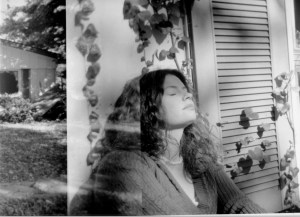
I have two works in the show from the Carrollton series:   Both images are self-portraits titled, ‘Until the End’ taken in front of one of my favorite homes, the last house on Chartley Drive that recently burned down.   The photograph is a double-exposure black and white 120 size film, 11×14 sized print.   The other work is a painting I did based from the composition of the photograph.     In the words of the curator and Holga guru Mark Fisher:  Its a wonderful, wonderful show.   Come check it out!   More info from the RFT here.

Six houses were taken down the week of December 15-22nd.   They were finishing removing the foundation of the last one on Gladwyn on Dec. 23rd, and began asbestos removal on Brampton by then.   Since this was an insanely busy week for me (and an insane holiday season),  I did not record the actual dates individually.   However, all 6 have been demolished within that week.

The six houses, two on Gladwyn and four on Pont, were all that remained of the subdivision south of 270.   All six of these houses had undergone a complete asbestos removal treatment including stripped of drywall down to bare studs.

All four homes on Pont were boarded up years ago back when they actually bothered to board up the vacated houses.   They stopped that practice around 2003 and let the vacant houses sit with broken windows, and the rest of the conditions we have seen.   Over time, those boards started to deteriorate due to environmental damage and brave the more braver vandals.   Overall, the houses on Pont were fairly safe from vandals thanks to their proximity and visibility to Natural Bridge and the Bridgeton Police Station and City Hall, as well as the still-occupied Carrollton Apartments.   I too didn’t stick around long enough for people to ask questions when I went over to this section of the neighborhood, but I really liked these houses and took photos when I could.   They were from the earliest Carrollton style, most having basements and other personalized accoutrements added to the exteriors.    With a bit of gingerbreading, seemingly more personalized yet sophisticated color choices, and updated interior styles beyond the year 1990 told me that their owners were probably holdouts who did not want to move.  These were some of the houses that were waiting for their fates in the court system, otherwise they would have been taken a long, long time ago.   Despite their broken, gray, rotten boards dangling and the broken windows they once concealed, they were the last pretty poster-children for what remained of the former Carrollton.

4229 Pont was the house closest to the runway that remained the longest.   One of my most favorite, most iconic compositions was taken with this house in the foreground in the shadow the the runway dominating  the background.   The house together with the runway signified in one frame all that happened in the last couple decades.  I didn’t go inside this house for years, but once the boards had fallen away and sunlight rushed in, I too wandered in and felt a bit of coziness.  What amazed me most was how a forgotten welcome mat remained in the same exact place before the front door for over five years.   A thin little brown mat sat ready to greet anyone as if time was not present.   It was unattached to the house physically, yet very much a part of the space as the wallpaper inside.   The little welcome mat was an element of humanity, in that you can tell that this was a place where a human had an emotional attachment with.   After over a year of any occupants in Carrollton, its easy to forget that these houses were loved, especially when you just drive by it and see them simply as wasted shells.  When you notice tiny details like this, that’s when you realize how important this place once was to someone.

4197 Pont was a beautiful green house with very pretty trees and lovely bushes in the yard.  This house had some personalization too, and it was the last one  in this area that I can remember in its prime.   Not exactly sure why I remember this place, but I do remember as a kid really liking the color and the shape of this house, as well as being impressed with its height on a hill.   It made the house appear larger, despite having the wonderful trees shade the yard.   I really just liked it.   It was beautiful inside and out.

The next green house on Pont did not have an identifyable # on the exterior.   418x or 417x are reasonable guesses.  I never went into this house until shortly before the asbestos crew came in and did their work.  Once they removed the plywood, the curiousity got to the best of me.  This place was almost too perfectly planned, with the living room window facing warm afternoon sunlight with just the right amount of patches of shade from the tree outside dancing on the floor with the sun’s glow.    The kitchen window faced out towards the west, watching countless sunsets before dinner’s preparation.   The house had laundry chute- something I wished our house had when I was a kid.   There was something very cool about this house, something that made me wish our house was more like this one.  This one, like all the rest on Pont was untouched with grafitti until its final days.

Although I was not brave enough to go inside this and the rest of the houses on Pont for years, I did keep my eye on these places and I took a fair # of shots of them before their demolitions.   So, I was exceptionally surprised when, quite randomly one day I drove past this house and had to turn around to double-check what I thought I saw.   In the neighboring yard yet very close to this house, a small homemade clay statue of a little girl had been placed in a circular garden of Engish ivy.   This statue only appeared last October and still remains there as of this writing, even with the destruction of the house.    I can only think about what this garden marker’s purpose is, and that this tiny tribute could be for something very solemn and sad.    Or, it could just be someone randomly leaving  homemade statues about.

4142 or 4124 Pont was a house so close to normal civilization that I did not dare to go near or inside it until after its asbestos removal was done, and enough trees have grown up around it mask myself inside.   This house was near the corner of Pont and Gladwyn and was covered in mud from the front yard.   The yard never seemed to be in good shape, and much of that was owed to this house acting as refuge for groundhogs.   Almost every time I drove by this place, one of these brown furry creatures were scurrying around the yard and would dive into their den just below the front walkway.  The front door was covered and caked with layers of muddy paw prints.   Something about entering  the home of a clan of groundhogs did not seem safe to me, so I stayed away.  Interestingly enough, this was the first house that had the asbestos treatment fully done, and I was so amazed at the webwork of 2x4s that kept our homes standing.   With all the walls gone, and nothing more than sunbeams and wood beams filling the interior, the space felt rather constricted and small, despite being a three bedroom home with a basement.     The one thing I loved the most about this home was the planks of wood driven into the tree in the front yard, leading to a long-absent treehouse.   The planks of wood again added that human element to this home.   The backward featured a neat little waterpond that had overgrown with ivy with time.

I’ll update this and write about the Gladwyn houses shortly.   I am also currently working on an update about the asbestos removal.  I have actually learned information that is quite surprising from the area’s asbestos inspector and a very kind man, Mr. Rick Whitney, whom spoke with me a week or so ago about the current asbestos removal.  One of the surprising facts I learned is that just because water was used in the demolition process (such as the process done on my own home in the photo above) did not necessarily make the demolition a ‘wet-method’ demo, as many of us had thought.  100 homes in the area are at fault at being an improper ‘wet-method’ demo in response to asbestos containment.   I am still doing a bit more research on this as well, reading the documents from the recent court case,  and will post about this matter and more of my enlightening disucssion with Mr. Whitney later.